In 1977 two small spacecraft left Earth for the giant planets. This page is their timeline, and it scrolls like their journey: crowded at first, when one discovery followed another, then quieter and quieter as they left the planets behind. The empty stretches are on purpose. Keep scrolling through them.
In the mid-1960s a student working at NASA's Jet Propulsion Laboratory, Gary Flandro, noticed something about the late 1970s. Jupiter, Saturn, Uranus and Neptune would sit in an order that let one spacecraft swing past each and be thrown on to the next.
Display · The alignment
Where Voyager 2 met each giant, 1979 to 1989: an arrangement around the Sun, not a straight line. The four fan out like this only about every 175 to 180 years.
The launch window ran from 1976 to 1979. Miss it, and the next chance would come round in about 175 years. NASA launched two Voyagers.
20 Aug 1977
Voyager 2
Voyager 2 launches first
A Titan IIIE-Centaur rocket lifts it off from Cape Canaveral. The names are not a mistake: Voyager 2 leaves first, on the slower, longer path.
5 Sep 1977
Voyager 1
Voyager 1 launches on a faster path
Sixteen days later Voyager 1 follows. Its shorter route means it will reach Jupiter four months ahead of its twin.
18 Sep 1977
Voyager 1
Earth and Moon in one picture
Looking back after less than two weeks, Voyager 1 takes the first single photo showing Earth and the Moon together.
19781979
5 Mar 1979
Voyager 1
Voyager 1 at Jupiter
It passes 277,400 km above the cloud tops, finds a faint ring and sees that the Great Red Spot is a huge storm.
9 Mar 1979
Voyager 1
A volcano on Io
Navigation engineer Linda Morabito spots a plume 270 km high on the edge of Io: the first active volcano seen anywhere beyond Earth.
9 Jul 1979 · Voyager 2 at Jupiter
How do you borrow speed from a planet?
Voyager 2 reached Jupiter moving at about 9.9 km/s around the Sun. That is too slow to go far: the Sun's pull would have dragged it back. But Jupiter is moving too, about 12.9 km/s along its orbit. Choose where to aim, and let Jupiter swing you towards Saturn.
Experiment
Slingshot
How do you borrow speed from a planet?
Goal Leave Jupiter at 18.5 km/s or more, heading for Saturn
Predict first. Seen from Jupiter, does Voyager leave faster than it arrived?
Not tried yetJupiter's pull only · flat 2D · speeds far from Jupiter
1980
12 Nov 1980
Voyager 1
A choice at Saturn: Titan
Voyager 1 swings within about 6,400 km of Titan to study its thick, mostly nitrogen air. That pass bends it up out of the planets' plane, so it can never visit another planet.
Display · The grand tour
Voyager 1 traded Uranus and Neptune for a close look at Titan. Because that worked, Voyager 2 went on, and it is still the only spacecraft to have visited Uranus and Neptune.
1981
25 Aug 1981
Voyager 2
Voyager 2 at Saturn
Because Titan worked, Voyager 2 is sent on. It passes 41,000 km above Saturn's clouds and finds the rings far more complicated than anyone expected.
19821983198419851986
24 Jan 1986
Voyager 2
The first visit to Uranus
10 new moons, two new rings and a strange, tilted magnetic field. Still the only visit Uranus has ever had.
198719881989
25 Aug 1989
Voyager 2
Neptune and Triton
Voyager 2 skims about 5,000 km over Neptune's north pole, finds 6 new moons and 4 rings, and sees dark plumes on its moon Triton rising about 8 km.
1990
14 Feb 1990
Voyager 1
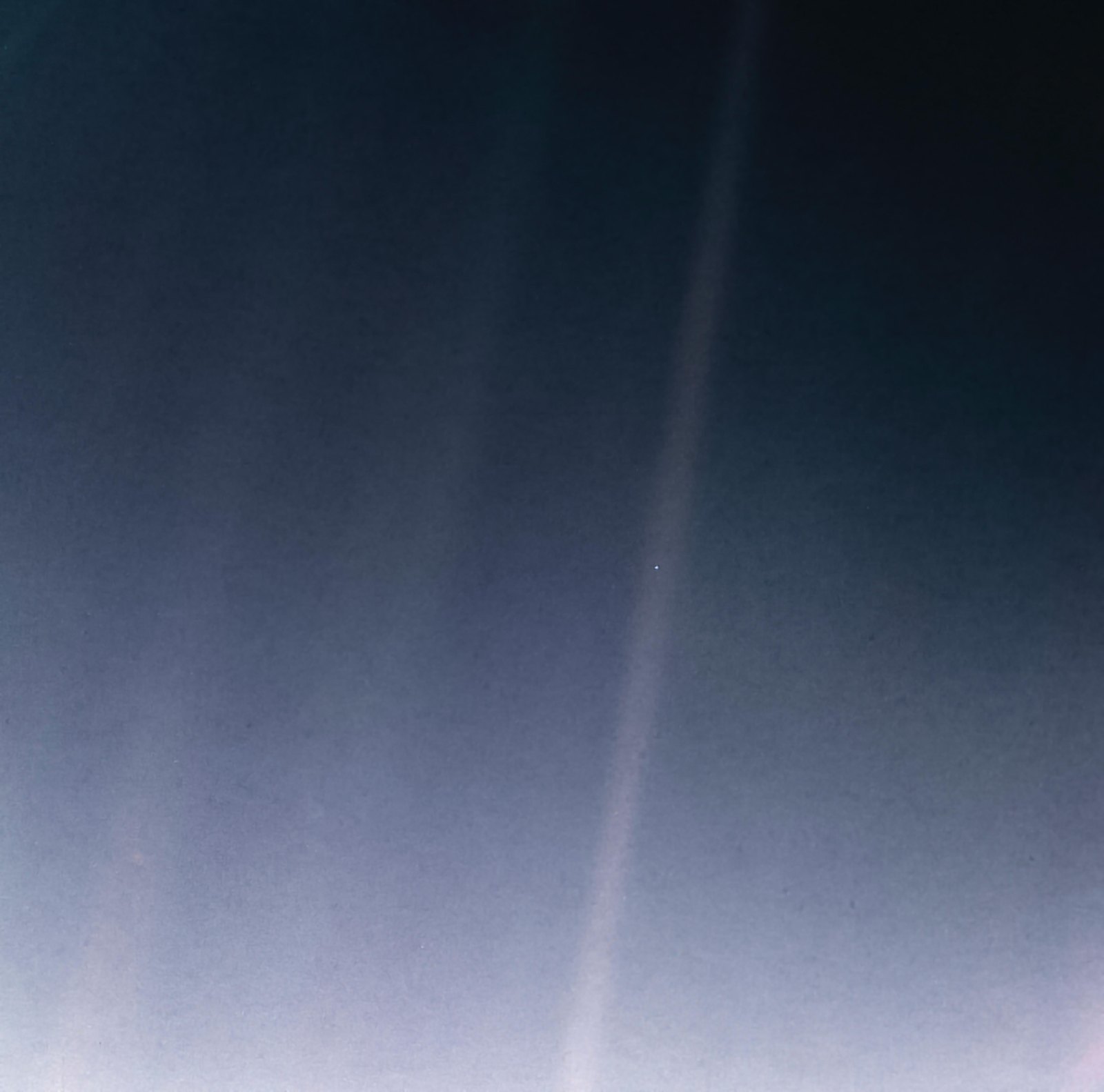
One last look back
Voyager 1 takes 60 pictures of the planets from behind, including one of Earth. Then its cameras are switched off for good. You will see that picture at the very end of this page.
19911992199319941995199619971998
17 Feb 1998
Voyager 1
The most distant thing we have made
Voyager 1 passes Pioneer 10. Nothing built by people has ever been further away.
199920002001200220032004
16 Dec 2004
Voyager 1
The solar wind slows down
At about 94.0 AU, Voyager 1 crosses the termination shock, where the Sun's wind of particles suddenly slows.
200520062007
30 Aug 2007
Voyager 2
Voyager 2 follows
Voyager 2 crosses the termination shock at about 83.7 AU.
20082009201020112012
25 Aug 2012
Voyager 1
Into interstellar space
At about 121.6 AU, Voyager 1 crosses the heliopause, the edge of the Sun's bubble, and becomes the first spacecraft in interstellar space. It is still inside the solar system: the Sun's farthest comets are much further out.
What would you send to say who we are?
Both Voyagers carry a 12-inch record of gold-plated copper, made in 1977 by a small team led by Carl Sagan. It holds greetings in 55 languages, the sounds of Earth, 115 pictures and 27 pieces of music. One copy is now in interstellar space. Here it is as text: play through the greetings or the sounds, or pick them one by one.
Experiment
The golden record
What would you send to say who we are?
Goal Play every greeting or every sound on the record
Predict first. How fast should a finder spin the record?
Not tried yetText only · greetings from NASA's list · no recordings played
20132014201520162017
28 Nov 2017
Voyager 1
Thrusters asleep for 37 years
Engineers fire a set of thrusters on Voyager 1 that had not been used since November 1980. They work.
2018
5 Nov 2018
Voyager 2
Voyager 2 reaches interstellar space
Voyager 2 crosses the heliopause at about 119.0 AU.
20192020202120222023
14 Nov 2023
Voyager 1
Nonsense from Voyager 1
Its data turns into a repeating pattern of ones and zeros. The cause is a single failed memory chip. Engineers move the code around it, one day of signal time each way.
2024
13 Jun 2024
Voyager 1
Science is back
All four of Voyager 1’s working instruments are sending useful data again.
20252026
17 Apr 2026
Voyager 1
Saving power
Its power drops about 4 watts a year as its plutonium decays. Another instrument is switched off to keep it going; 2 are left.
Now
How long does a message take to reach Voyager 1 today?
Voyager 1 is now so far away that a radio message, moving at the speed of light, takes almost a whole day to get there. Write something and send it. It will be saved, and it will arrive while you are doing something else.
Experiment
The long call
How long does a message take to reach Voyager 1 today?
Goal Send Voyager 1 a message and see when it arrives
Predict first. If Voyager answered straight away, when would you get the reply?
Not tried yetLight time worked out for today · one way · speed of light
18 Nov 2026 · about 10:16 UTC
Voyager 1
One light-day from home
Voyager 1 reaches 25.9 billion km from Earth. Light leaving Earth at that moment takes a whole day to catch it.
That is where the dates run out. Everything after this is a projection.
In about 300 years Voyager 1 reaches the inner edge of the Oort Cloud, the far swarm of icy bodies around the Sun. Getting through it will take about 30,000 years. Around AD 40272 it passes within 1.7 light-years of a star called AC+79 3888. By then its power will long be gone, but the record will still be on board.
Display · Looking back
Earth
That's us, from about 6 billion kilometres: Voyager 1 looking back on 14 February 1990. Earth is less than a single pixel; the circle is ours, the speck is not enlarged.
"Pale Blue Dot Revisited" (PIA23645), reprocessed in 2020. Courtesy NASA/JPL-Caltech. The bands of light are sunlight scattered inside the camera, not real beams.
This is the last room. Thank you for staying after closing.